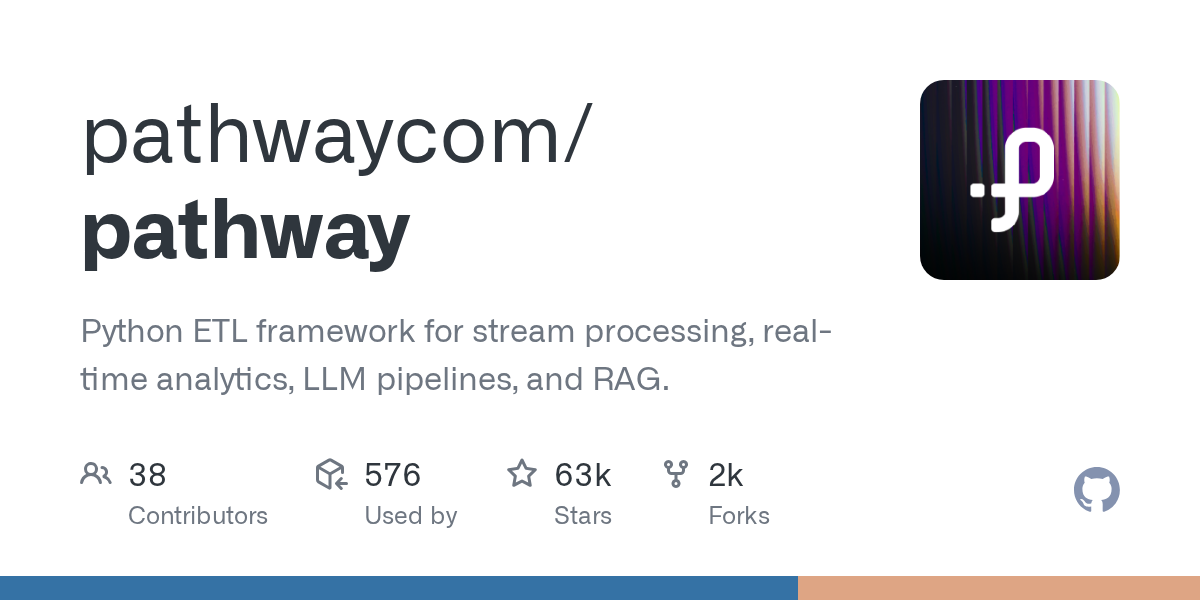
📊 Stats & Trend
| ⭐ Stars (total) | 62,720 |
| 📈 Star Growth (Mar 20 → Mar 27) | +62,720 |
| 🔥 Star Growth (Mar 26 → Mar 27) | +108 |
| 🔥 Trend | Exploding |
| 📊 Trend Score | 50176 |
| 💻 Stack | Python |
Overview
Pathway has exploded onto the GitHub scene with +62,720 stars gained this week, establishing itself as a comprehensive Python framework for real-time data processing. The tool combines stream processing, ETL capabilities, and modern AI pipeline functionality including RAG implementations. Its rapid adoption indicates strong developer demand for unified solutions that handle both traditional data workflows and cutting-edge LLM applications.
Key Features
• Stream processing engine for handling real-time data flows with Python-native implementation
• ETL framework supporting data extraction, transformation, and loading operations
• LLM pipeline integration for building and managing large language model workflows
• RAG (Retrieval-Augmented Generation) capabilities for enhanced AI applications
• Real-time analytics processing for immediate data insights
• Python-first architecture designed for data scientists and ML engineers
Use Cases
• Building real-time recommendation systems that process user behavior streams and update model responses instantly
• Creating RAG applications that combine live data ingestion with LLM querying for up-to-date information retrieval
• Developing financial trading platforms that require immediate processing of market data streams
• Implementing IoT data pipelines that transform sensor data in real-time for monitoring dashboards
• Constructing chatbots that access live databases and external APIs through RAG patterns
Why It’s Trending
This tool gained +62,720 stars this week, showing explosive momentum in AI Infrastructure. This suggests increasing developer interest in unified frameworks that bridge traditional data engineering with modern AI capabilities. This trend may reflect a broader shift toward integrated solutions as teams seek to reduce complexity when building AI-powered applications that require real-time data processing.
Pros
• Combines multiple data processing paradigms in a single Python framework
• Native support for modern AI workflows including LLM and RAG implementations
• Real-time processing capabilities eliminate latency in data-driven applications
• Python-centric design aligns with existing ML and data science toolchains
Cons
• Very new project may lack production-tested stability and comprehensive documentation
• Single-language focus limits adoption in polyglot development environments
• Performance characteristics unclear compared to specialized streaming platforms
Pricing
Open source and free to use under standard GitHub licensing.
Getting Started
Install via pip and explore the Python API for stream processing and ETL operations. The framework provides examples for both traditional data workflows and AI pipeline implementations.
Insight
The explosive growth suggests that developers are actively seeking solutions that unify traditional ETL processes with modern AI capabilities. This momentum may reflect the increasing complexity of building production AI systems that require both real-time data processing and LLM integration. The trend toward all-in-one frameworks indicates that teams are prioritizing reduced tool sprawl over specialized point solutions when architecting AI-driven applications.

Comments