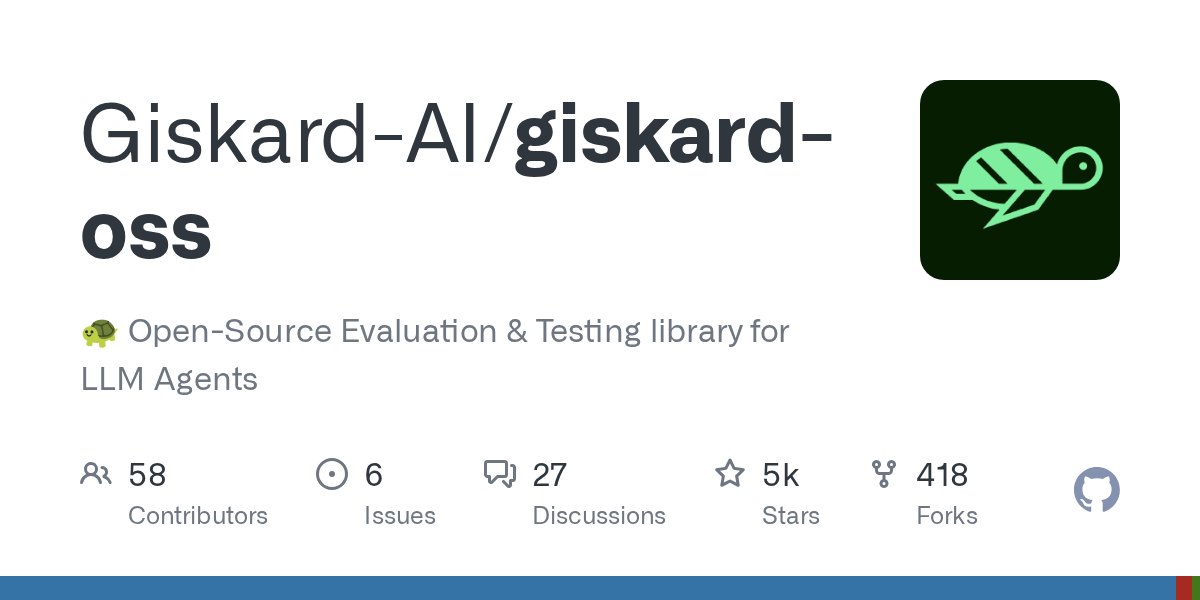
📊 Stats & Trend
| ⭐ Stars (total) | 5,198 |
| 📈 Star Growth (Mar 19 → Mar 26) | +5,198 |
| 🔥 Star Growth (Mar 25 → Mar 26) | +5,198 |
| 📈 Trend | Trending |
| 📊 Trend Score | 4158 |
| 💻 Stack | Python |
Overview
Giskard-oss has emerged as a significant player in the LLM Agent testing space, gaining massive developer attention with +5,198 stars this week alone. This open-source Python library focuses specifically on evaluation and testing for LLM-powered agents, addressing a critical gap in the AI development toolkit as teams struggle with reliable assessment methods for agent-based systems.
Key Features
• Specialized evaluation framework designed specifically for LLM Agent testing and validation
• Open-source Python library with dedicated focus on agent performance assessment
• Testing infrastructure that supports systematic evaluation of AI agent behaviors
• Integration capabilities for existing Python-based AI development workflows
• Evaluation metrics and benchmarking tools tailored for agent-specific use cases
• Community-driven development model allowing for rapid iteration and feature additions
Use Cases
• AI development teams building autonomous agents that need systematic performance validation
• Research organizations studying LLM agent behaviors and requiring standardized testing protocols
• Enterprise teams deploying AI agents in production environments who need reliability assurance
• Machine learning engineers developing multi-agent systems requiring comprehensive evaluation frameworks
• Startups building agent-based AI products who need cost-effective testing solutions
Why It’s Trending
This tool gained +5,198 stars this week, showing strong momentum in AI Agents. This suggests increasing developer interest in specialized testing approaches for LLM-powered systems rather than generic AI evaluation tools. This trend may reflect a broader shift in how teams are building with AI, moving from simple chatbot implementations toward more complex agent architectures that require dedicated testing infrastructure.
Pros
• Open-source model provides free access to enterprise-grade agent testing capabilities
• Python-native implementation integrates seamlessly with existing ML development stacks
• Specialized focus on LLM agents rather than generic AI testing approaches
• Community-driven development ensures rapid response to emerging agent testing needs
Cons
• Limited to Python ecosystem, potentially excluding teams using other programming languages
• Being a newer project, it may lack the maturity and extensive documentation of established testing frameworks
• Specialized focus means it may not address broader AI testing needs beyond agent evaluation
Pricing
Completely free as an open-source project. No indication of paid tiers or commercial licensing requirements.
Getting Started
Install via Python package managers and integrate into existing LLM agent development workflows. The library appears designed for developers already working with Python-based AI systems.
Insight
The explosive growth suggests that developer teams are encountering significant challenges in validating LLM agent performance using existing tools. This rapid adoption may reflect the maturation of agent-based AI development, where teams are moving beyond proof-of-concept phases toward production deployments requiring robust testing frameworks. The timing indicates that the market is likely driven by the gap between sophisticated agent capabilities and available evaluation infrastructure.
Comments