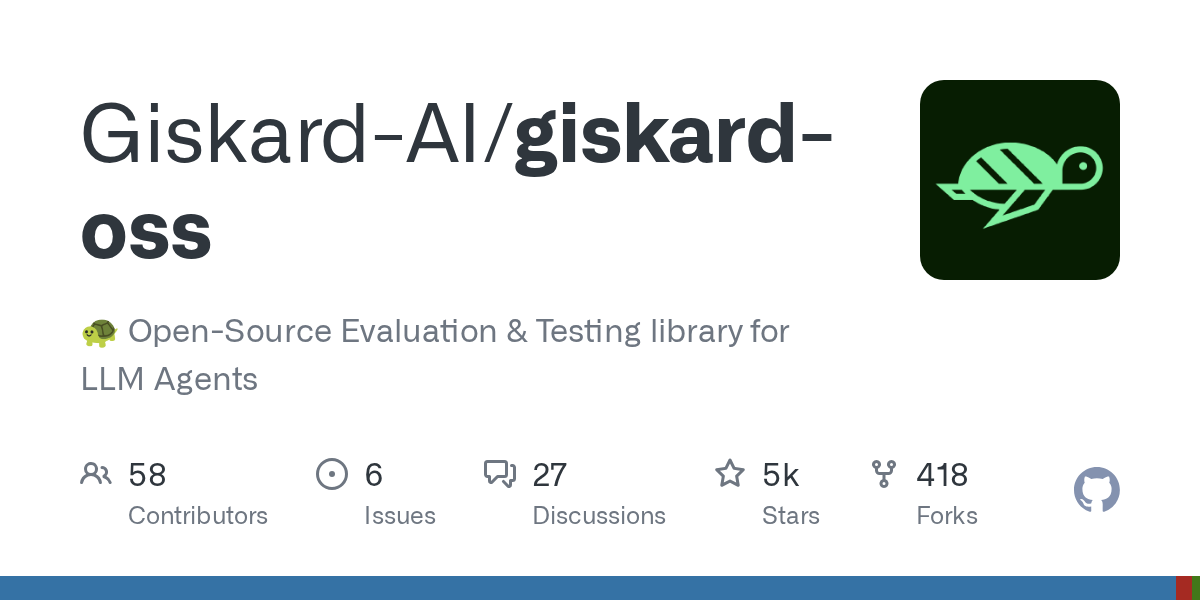
📊 Stats & Trend
| ⭐ Stars (total) | 5,198 |
| 📈 Star Growth (Mar 19 → Mar 26) | +5,198 |
| 🔥 Star Growth (Mar 25 → Mar 26) | +2 |
| 📈 Trend | Trending |
| 📊 Trend Score | 4158 |
| 💻 Stack | Python |
Overview
Giskard-oss has emerged as a specialized evaluation framework for LLM agents, capturing significant developer attention with +5,198 stars this week. This open-source Python library addresses the growing need for systematic testing and validation of AI agent systems as teams move beyond basic chatbots toward more complex autonomous workflows.
Key Features
• Comprehensive evaluation suite specifically designed for LLM-powered agents and autonomous systems
• Built-in testing framework to validate agent behavior, decision-making, and multi-step reasoning
• Python-native integration allowing seamless incorporation into existing ML pipelines and workflows
• Open-source architecture enabling customization and extension for specific agent use cases
• Systematic approach to measuring agent performance across different scenarios and edge cases
• Testing utilities for evaluating agent reliability, safety, and alignment with intended objectives
Use Cases
• AI research teams validating autonomous agent systems before deployment in production environments
• Enterprise developers building reliable AI agents for customer service, sales, or internal automation workflows
• ML engineers implementing continuous testing pipelines for agent-based applications and multi-step AI workflows
• Companies developing AI products that require systematic evaluation of agent behavior and decision quality
• Organizations ensuring AI agent safety and reliability in regulated industries or high-stakes applications
Why It’s Trending
This tool gained +5,198 stars this week, showing strong momentum in AI agent evaluation and testing infrastructure. This suggests increasing developer interest in systematic approaches to validating complex AI systems beyond traditional model evaluation. This trend may reflect a broader shift toward production-ready AI agents where reliability and systematic testing become critical requirements.
Pros
• Addresses a specific gap in the AI tooling ecosystem with focused agent evaluation capabilities
• Open-source approach allows for community contributions and customization for diverse agent architectures
• Python-first design integrates naturally with existing ML and AI development workflows
• Timing aligns well with industry movement toward more sophisticated agent-based AI applications
Cons
• Relatively new project may lack the extensive documentation and community resources of established tools
• Agent evaluation remains a rapidly evolving field with unclear standardization across different approaches
• Limited track record in production environments compared to more mature testing frameworks
Pricing
Free and open-source under standard open-source licensing. No paid tiers or enterprise versions are currently indicated.
Getting Started
Install via pip from the GitHub repository and integrate into existing Python-based AI development workflows. The library provides evaluation frameworks that can be configured for specific agent architectures and testing requirements.
Insight
The rapid adoption of Giskard-oss suggests that teams are encountering real challenges in validating AI agent systems as they move beyond simple question-answering toward autonomous workflows. This growth pattern indicates that systematic agent evaluation may be becoming a required capability rather than an optional enhancement. The timing likely reflects the maturation of the AI agent space where reliability and testing infrastructure is becoming as important as the underlying models themselves.
Comments