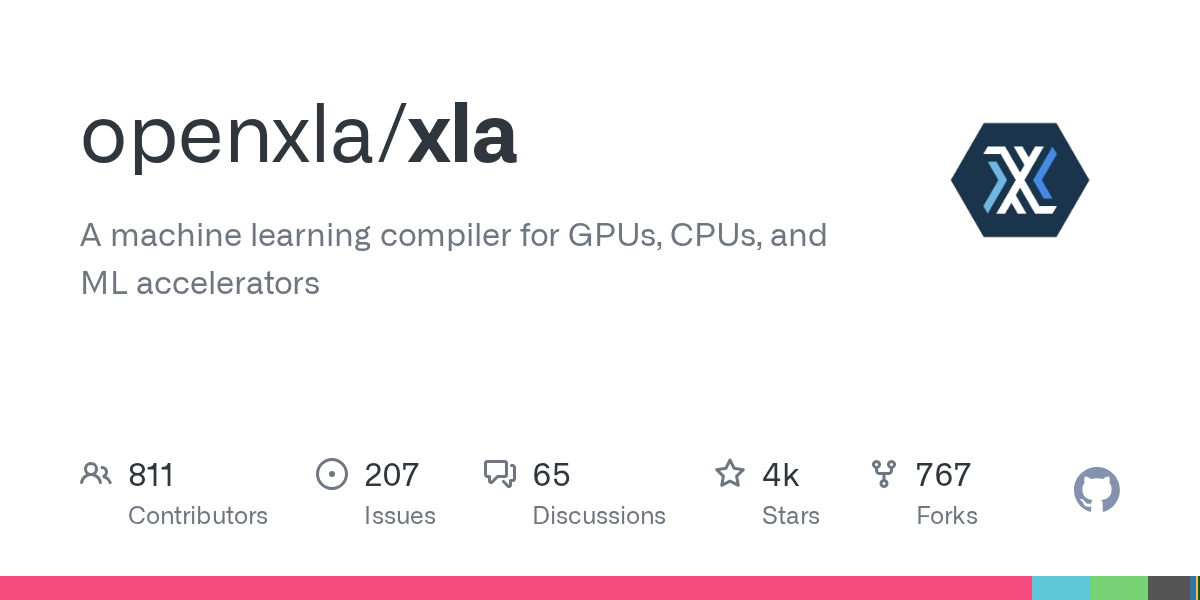
📊 Stats & Trend
| ⭐ Stars (total) | 4,110 |
| 📈 Star Growth (Mar 17 → Mar 24) | +4,110 |
| 🔥 Star Growth (Mar 23 → Mar 24) | +3 |
| 📈 Trend | Trending |
| 📊 Trend Score | 3288 |
| 💻 Stack | C++ |
Overview
XLA is experiencing explosive growth with +4,110 stars gained this week, establishing itself as a significant player in the machine learning infrastructure space. This Google-developed compiler optimizes ML computations across diverse hardware platforms including GPUs, CPUs, and specialized ML accelerators, making it a critical component for performance-sensitive AI applications.
Key Features
• Cross-platform compilation for GPUs, CPUs, and ML accelerators with unified optimization
• Just-in-time and ahead-of-time compilation modes for different deployment scenarios
• Automatic memory management and buffer optimization to reduce overhead
• Graph-level optimizations including operator fusion and layout transformations
• Integration with TensorFlow and JAX ecosystems as the backend compiler
• Support for custom ops and hardware-specific optimizations
Use Cases
• High-performance training of large language models and neural networks requiring maximum compute efficiency
• Production ML inference deployments where latency and throughput are critical business requirements
• Research environments needing to experiment with custom hardware accelerators and optimization strategies
• Edge computing applications requiring optimized models for resource-constrained devices
• Multi-GPU distributed training workloads that benefit from cross-device optimization
Why It’s Trending
This tool gained +4,110 stars this week, showing strong momentum in AI compiler technology. This suggests increasing developer interest in low-level ML optimization as models grow larger and more computationally demanding. This trend may reflect a broader shift toward infrastructure-level performance optimization as AI applications move from research to production scale.
Pros
• Significant performance improvements through advanced compiler optimizations and memory management
• Hardware agnostic design allows same code to run efficiently across different accelerator types
• Battle-tested in production environments powering Google’s ML infrastructure
• Strong integration with popular ML frameworks reduces adoption friction
Cons
• Steep learning curve for developers unfamiliar with compiler internals and low-level optimization
• Debugging optimized code can be complex when compilation transforms obscure original logic
• Limited documentation for advanced customization and hardware-specific tuning
Pricing
Open source and completely free to use under Apache 2.0 license.
Getting Started
XLA is typically accessed through TensorFlow or JAX rather than used directly. Enable XLA compilation in your existing ML framework by adding the appropriate compilation flags or decorators.
Insight
The dramatic growth in XLA adoption suggests that performance optimization is becoming a top priority as AI workloads scale beyond traditional compute capabilities. This trend is likely driven by the increasing costs of training large models and the need for efficient inference in production environments. The timing may reflect a maturation phase where the ML community is shifting focus from model innovation to infrastructure efficiency and deployment optimization.


Comments