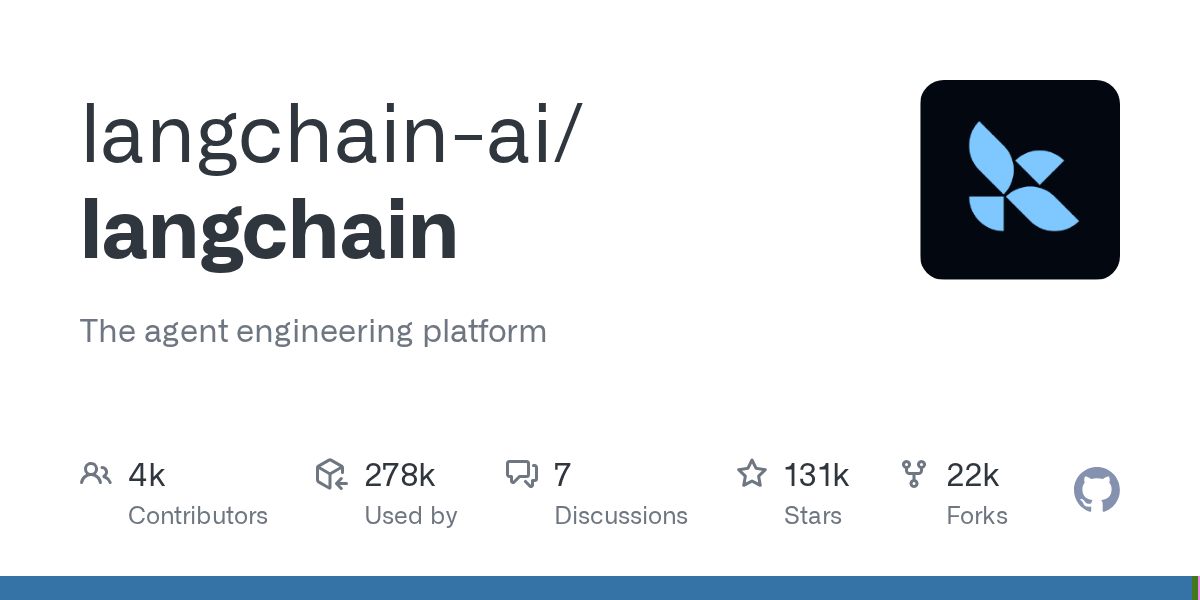
📊 Stats & Trend
| ⭐ Stars (total) | 131,209 |
| 📈 Star Growth (Mar 20 → Mar 27) | +131,209 |
| 🔥 Star Growth (Mar 26 → Mar 27) | +100 |
| 🔥 Trend | Exploding |
| 📊 Trend Score | 104967 |
| 💻 Stack | Python |
Overview
LangChain has emerged as a dominant force in the agent engineering space, gaining massive developer adoption with 131,209 total GitHub stars. The platform’s explosive weekly growth of +131,209 stars and consistent daily momentum of +100 stars positions it as one of the fastest-growing tools in the AI development ecosystem right now.
Key Features
• Agent orchestration framework for building complex AI workflows and multi-step reasoning systems
• Chain composition tools that connect multiple language model calls and data processing steps
• Memory management capabilities for maintaining context across agent interactions
• Integration ecosystem supporting major LLM providers, vector databases, and external APIs
• Built-in tools for prompt engineering, output parsing, and response validation
• Modular architecture allowing developers to mix and match components for custom agent behaviors
Use Cases
• Building conversational AI agents that can perform research, analysis, and multi-step problem solving
• Creating automated workflows that combine language models with databases, APIs, and business systems
• Developing intelligent document processing systems that can extract, analyze, and act on information
• Implementing customer support bots with complex reasoning and external system integration capabilities
• Prototyping AI applications that require sequential decision-making and tool usage
Why It’s Trending
This tool gained +131,209 stars this week, showing strong momentum in AI Agents. This suggests increasing developer interest in this approach. This trend may reflect a broader shift in how teams are building with AI, moving beyond simple chat interfaces toward more sophisticated agent-based architectures.
Pros
• Comprehensive ecosystem with extensive integrations and community-contributed components
• Strong documentation and active community support for troubleshooting and best practices
• Modular design allows developers to use only needed components without framework bloat
• Regular updates and feature additions keeping pace with rapidly evolving AI landscape
Cons
• Learning curve can be steep for developers new to agent-based AI architectures
• Complex chains can become difficult to debug and maintain as applications grow
• Performance overhead from abstraction layers may impact latency-sensitive applications
Pricing
Open source and free to use. Underlying LLM and service costs apply separately based on chosen integrations.
Getting Started
Install via pip and follow the quickstart guide to build your first agent chain. The extensive documentation includes tutorials for common patterns and integration examples.
Insight
The explosive growth in LangChain’s adoption suggests that developers are increasingly moving beyond simple LLM integrations toward more sophisticated agent architectures. This momentum likely reflects the maturation of the AI development space, where teams are now building production systems that require complex reasoning and tool integration capabilities. The consistent daily growth indicates that this shift toward agent-based development may represent a fundamental change in how AI applications are architected.


Comments