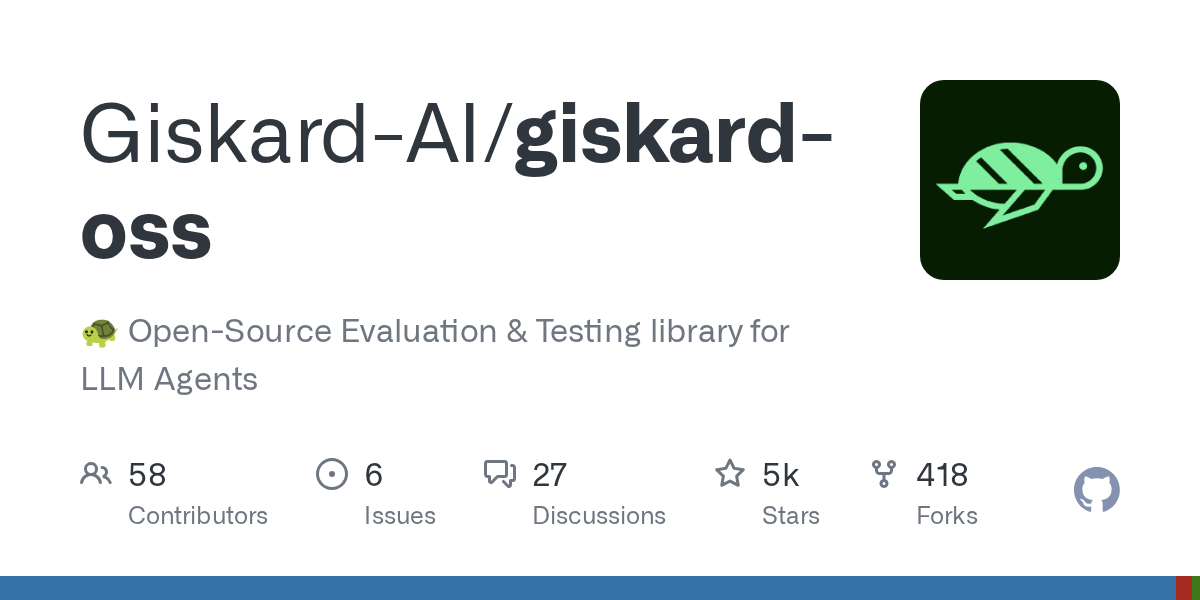
📊 Stats & Trend
| ⭐ Stars (total) | 5,198 |
| 📈 Star Growth (Mar 19 → Mar 26) | +5,198 |
| 🔥 Star Growth (Mar 25 → Mar 26) | +5,198 |
| 📈 Trend | Trending |
| 📊 Trend Score | 4158 |
| 💻 Stack | Python |
Overview
Giskard-OSS is making waves as an open-source evaluation and testing library specifically designed for LLM agents. With +5,198 stars gained this week, this Python-based tool is capturing significant developer attention in the rapidly evolving AI agent ecosystem.
Key Features
• Comprehensive testing framework for LLM agent evaluation and validation
• Built-in metrics and benchmarks for assessing agent performance and reliability
• Integration capabilities with popular Python ML and AI development workflows
• Automated testing pipelines for continuous evaluation of agent behavior
• Support for various LLM architectures and agent implementations
• Quality assurance tools for production-ready AI agent deployment
Use Cases
• AI researchers testing and validating experimental agent architectures before publication
• Enterprise teams ensuring LLM agents meet reliability standards before production deployment
• Developer teams building automated testing pipelines for AI-powered applications
• Organizations conducting comparative analysis between different agent implementations
• Quality assurance teams establishing testing protocols for AI agent performance monitoring
Why It’s Trending
This tool gained +5,198 stars this week, showing strong momentum in AI Agents. This suggests increasing developer interest in systematic evaluation approaches for LLM-based systems. This trend may reflect a broader shift toward more rigorous testing standards as AI agents move from experimental prototypes to production applications.
Pros
• Open-source approach provides transparency and community-driven development
• Python-native implementation integrates seamlessly with existing ML workflows
• Addresses critical gap in LLM agent testing infrastructure
• Growing community support and active development momentum
Cons
• Relatively new project may lack extensive documentation and established best practices
• Limited ecosystem maturity compared to traditional software testing frameworks
• Potential learning curve for teams unfamiliar with AI agent evaluation methodologies
Pricing
Completely free as an open-source project available on GitHub.
Getting Started
Install via pip and access the GitHub repository for documentation and examples. The Python-native design enables quick integration into existing development environments.
Insight
The explosive growth in stars suggests that developer teams are increasingly recognizing the need for systematic testing approaches in AI agent development. This momentum indicates that the industry may be transitioning from ad-hoc evaluation methods toward more structured quality assurance frameworks. The timing of this growth is likely driven by the maturation of LLM agent applications and the corresponding demand for production-ready evaluation tools.
Comments