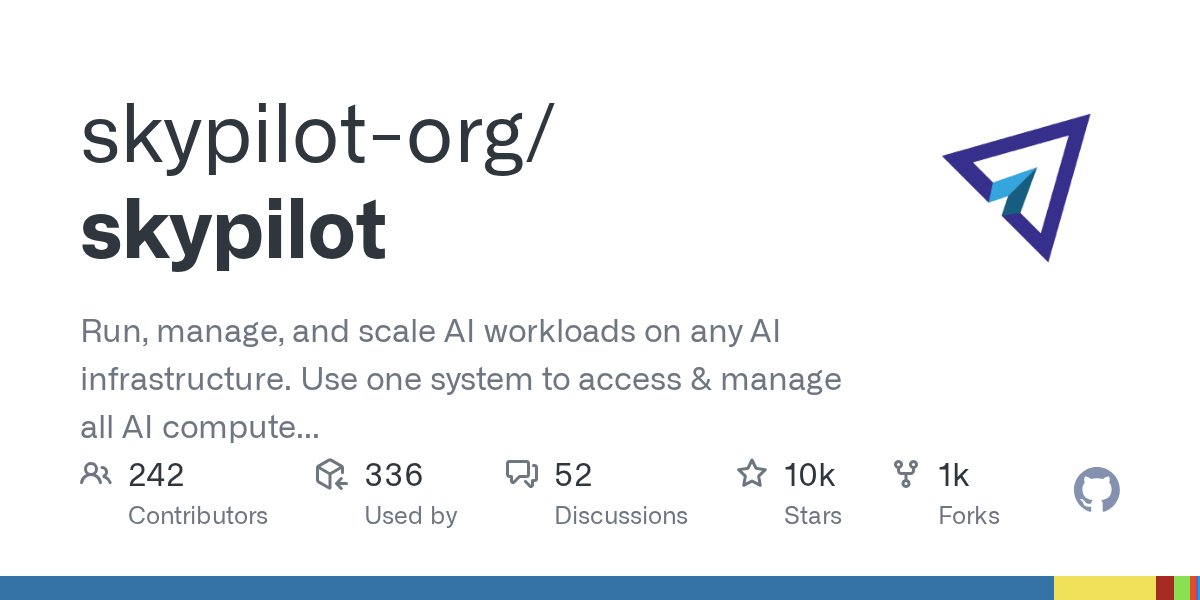
📊 Stats & Trend
| ⭐ Stars (total) | 9,703 |
| 📈 Star Growth (Mar 19 → Mar 26) | +9,703 |
| 🔥 Star Growth (Mar 25 → Mar 26) | +9,703 |
| 📈 Trend | Trending |
| 📊 Trend Score | 7762 |
| 💻 Stack | Python |
Overview
SkyPilot has emerged as a significant player in AI infrastructure management, gaining 9,703 stars this week. This Python-based tool addresses the growing complexity of managing AI workloads across multiple cloud providers and infrastructure types, positioning itself as a unified control plane for AI compute resources.
Key Features
• Unified management across 20+ cloud providers including AWS, GCP, Azure, and on-premises infrastructure
• Kubernetes and Slurm cluster integration for workload orchestration
• Multi-cloud cost optimization through intelligent resource allocation
• Automated scaling capabilities for AI training and inference workloads
• Python-native API for seamless integration with existing ML pipelines
• Infrastructure abstraction layer that simplifies cloud resource provisioning
Use Cases
• ML engineers running distributed training jobs across multiple cloud regions to optimize costs and availability
• Research teams managing compute-intensive experiments that require dynamic scaling across different infrastructure providers
• AI companies implementing multi-cloud strategies to avoid vendor lock-in while maintaining operational efficiency
• Organizations with hybrid cloud setups needing to coordinate workloads between on-premises clusters and public cloud resources
• DevOps teams automating AI model deployment pipelines across heterogeneous infrastructure environments
Why It’s Trending
This tool gained +9,703 stars this week, showing strong momentum in AI Infrastructure. This suggests increasing developer interest in unified multi-cloud AI workload management solutions. This trend may reflect a broader shift toward infrastructure abstraction as AI workloads become more complex and distributed across multiple providers.
Pros
• Eliminates vendor lock-in by providing consistent interface across multiple cloud providers
• Reduces infrastructure management overhead through automation and abstraction
• Offers cost optimization potential through intelligent multi-cloud resource allocation
• Integrates well with existing Python-based ML workflows and toolchains
Cons
• Adds another layer of abstraction that may complicate debugging infrastructure issues
• Requires learning new APIs and concepts even for teams familiar with individual cloud providers
• May introduce latency or overhead compared to direct cloud provider integrations
Pricing
Open source and free to use. Users only pay for the underlying cloud infrastructure resources consumed.
Getting Started
Install via pip and configure cloud credentials for your target providers. The Python API allows you to define and launch workloads with minimal setup.
Insight
The rapid adoption suggests that AI teams are increasingly facing infrastructure complexity challenges that single-cloud solutions cannot address effectively. This momentum indicates that multi-cloud AI workload management may be transitioning from a nice-to-have to an operational necessity. The timing likely reflects the maturation of AI workloads beyond experimental phases, where cost optimization and infrastructure flexibility become critical business requirements.

Comments