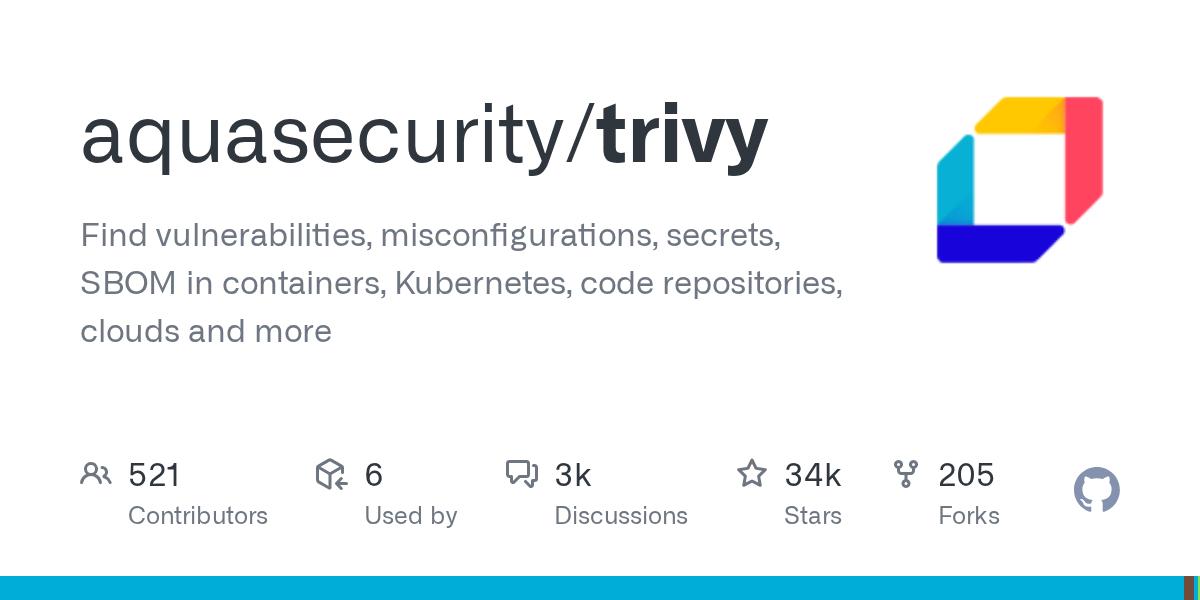
📊 Stats & Trend
| ⭐ Stars (total) | 34,127 |
| 📈 Star Growth (Mar 19 → Mar 26) | +34,127 |
| 🔥 Star Growth (Mar 25 → Mar 26) | +34,127 |
| 🔥 Trend | Exploding |
| 📊 Trend Score | 27302 |
| 💻 Stack | Go |
Overview
Trivy is experiencing explosive growth with +34,127 stars this week, positioning itself as a comprehensive security scanner for modern development workflows. This Go-based tool addresses the critical need for vulnerability detection across containers, Kubernetes clusters, code repositories, and cloud infrastructure in a single unified platform.
Key Features
- Multi-target vulnerability scanning for containers, filesystems, code repositories, and cloud resources
- Misconfiguration detection for Kubernetes, Docker, Terraform, and other infrastructure-as-code tools
- Secret detection capabilities to identify exposed API keys, passwords, and tokens in codebases
- Software Bill of Materials (SBOM) generation for supply chain security compliance
- Integration with CI/CD pipelines through multiple output formats and exit codes
- Offline scanning capabilities with local vulnerability databases
Use Cases
- DevSecOps teams integrating security scans into CI/CD pipelines before container deployments
- Security engineers auditing Kubernetes clusters for misconfigurations and known vulnerabilities
- Compliance teams generating SBOMs for software supply chain transparency requirements
- Platform engineering teams implementing security gates across multi-cloud infrastructure
- Open source maintainers scanning repositories for accidentally committed secrets or dependencies with known CVEs
Why It’s Trending
This tool gained +34,127 stars this week, showing explosive momentum in the security tooling space. This suggests increasing developer urgency around integrated security scanning as container adoption accelerates. This trend may reflect a broader shift toward “shift-left” security practices where vulnerability detection becomes embedded in development workflows rather than treated as a separate security team responsibility.
Pros
- Comprehensive scanning across multiple target types eliminates need for separate security tools
- Fast scanning performance with minimal resource overhead suitable for CI/CD integration
- Extensive vulnerability database coverage including OS packages, language-specific dependencies, and infrastructure misconfigurations
- Strong ecosystem integration with major CI platforms, container registries, and Kubernetes distributions
Cons
- High volume of scan results may require significant tuning to reduce false positives in large codebases
- Complex configuration options can overwhelm teams new to automated security scanning
- Database updates and maintenance required for accurate offline scanning scenarios
Pricing
Free and open source under Apache 2.0 license. Enterprise support and additional features available through Aqua Security’s commercial offerings.
Getting Started
Install via package managers or download binaries directly from GitHub releases. Run basic container scans with simple commands like trivy image [IMAGE_NAME] or integrate into existing CI workflows using provided GitHub Actions and Jenkins plugins.
Insight
The explosive growth pattern suggests that security scanning tools are reaching a tipping point where developer adoption is likely driven by regulatory compliance requirements and high-profile supply chain attacks. This momentum may reflect increasing organizational pressure to implement automated security controls as container-based deployments become standard practice across enterprise environments.

Comments