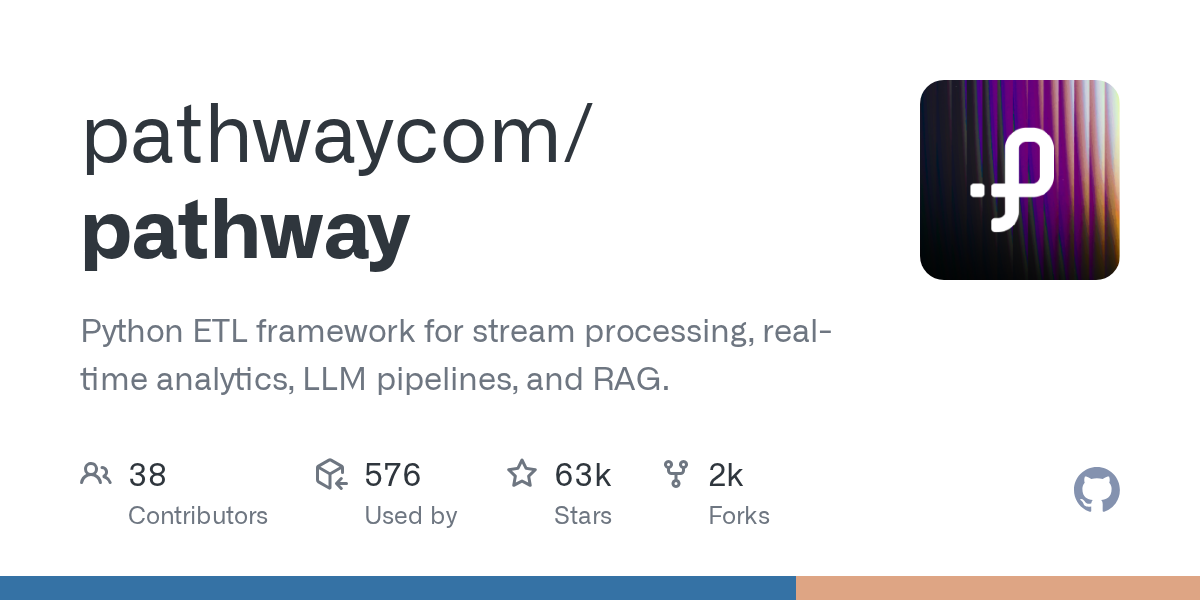
📊 Stats & Trend
| ⭐ Stars (total) | 62,613 |
| 📈 Star Growth (Mar 19 → Mar 26) | +62,613 |
| 🔥 Star Growth (Mar 25 → Mar 26) | +62,613 |
| 🔥 Trend | Exploding |
| 📊 Trend Score | 50090 |
| 💻 Stack | Python |
Overview
Pathway has exploded onto the scene with +62,613 stars in a single week, positioning itself as a comprehensive Python ETL framework that bridges traditional stream processing with modern AI workflows. The tool specifically targets real-time analytics, LLM pipelines, and RAG (Retrieval-Augmented Generation) implementations, making it highly relevant for current AI development needs.
Key Features
• Stream processing engine built specifically for Python developers working with real-time data
• Native support for LLM pipeline construction and management
• RAG implementation capabilities for retrieval-augmented generation workflows
• ETL framework designed for handling continuous data streams rather than batch processing
• Real-time analytics processing with focus on AI workloads
• Python-first architecture optimized for machine learning and AI use cases
Use Cases
• Building real-time RAG systems that continuously update knowledge bases and respond to queries
• Creating LLM pipelines that process streaming data for chatbots, content generation, or analysis
• Implementing real-time analytics dashboards that incorporate AI-generated insights
• Developing ETL workflows for ML model training data that requires continuous updates
• Processing live data streams for AI applications like recommendation engines or fraud detection
Why It’s Trending
This tool gained +62,613 stars this week, showing strong momentum in AI Infrastructure. This suggests increasing developer interest in frameworks that specifically address the intersection of traditional data engineering and modern AI workflows. This trend may reflect a broader shift toward real-time AI applications where traditional batch processing approaches are insufficient for responsive, intelligent systems.
Pros
• Addresses the specific challenge of combining stream processing with AI workflows in one framework
• Python-native design aligns with the dominant language in AI development
• Focuses on real-time processing, which is increasingly important for responsive AI applications
• Targets popular AI patterns like RAG and LLM pipelines that many developers are currently implementing
Cons
• As a new framework, likely has limited community resources and documentation compared to established alternatives
• May have a learning curve for teams already invested in other stream processing solutions
• Unclear how it compares performance-wise to specialized streaming or AI pipeline tools
Pricing
Open source and free to use.
Getting Started
Install via Python package manager and follow the documentation for setting up your first stream processing pipeline. The framework appears designed to integrate with existing Python AI development workflows.
Insight
The explosive growth suggests that developers are actively seeking tools that unify data streaming with AI workloads rather than managing separate systems. This momentum may reflect the maturation of AI applications beyond experimental phases toward production systems that require real-time data processing. The timing indicates that teams are likely encountering limitations with existing tools when building responsive AI applications that need continuous data updates.
Comments