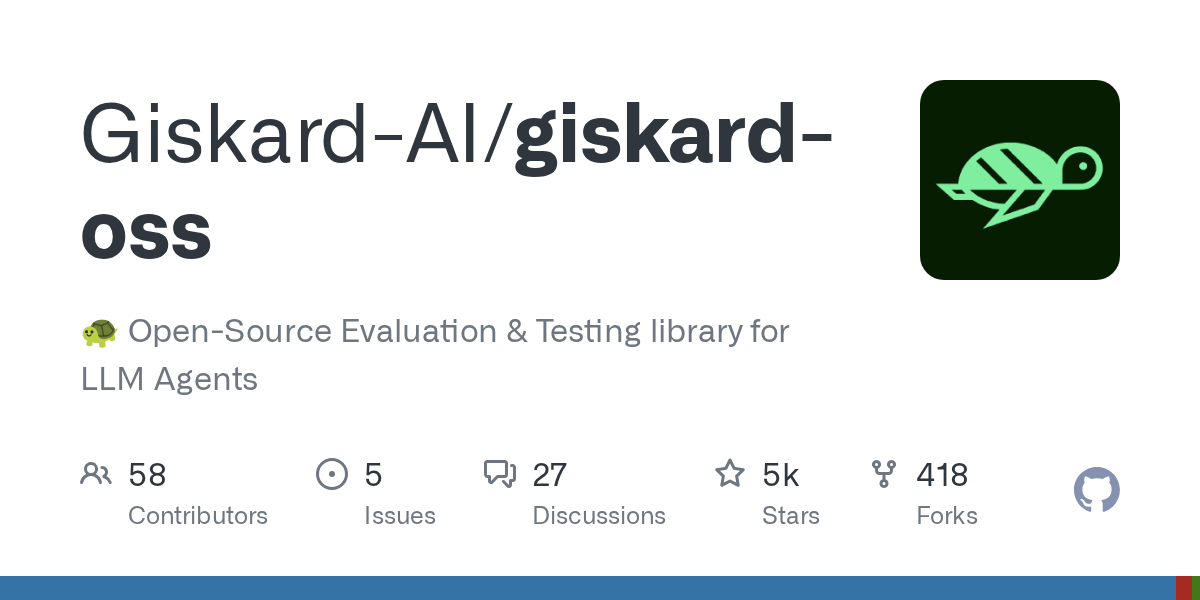
📊 Stats & Trend
| ⭐ Stars (total) | 5,196 |
| 📈 Star Growth (Mar 18 → Mar 25) | +5,196 |
| 🔥 Star Growth (Mar 24 → Mar 25) | +5,196 |
| 📈 Trend | Trending |
| 📊 Trend Score | 4157 |
| 💻 Stack | Python |
Overview
Giskard-oss is an open-source evaluation and testing library specifically designed for LLM agents, gaining significant developer attention with +5,196 stars this week. This Python-based tool addresses the growing need for systematic testing frameworks as AI agent development moves from experimentation to production deployment.
Key Features
• Comprehensive evaluation framework for LLM agent performance and reliability
• Built-in testing suites for agent behavior validation and quality assurance
• Python-native integration for seamless incorporation into existing ML workflows
• Open-source architecture allowing customization and community contributions
• Specialized focus on agent-specific testing scenarios beyond traditional model evaluation
• Framework-agnostic design supporting various LLM agent implementations
Use Cases
• AI development teams testing agent reliability before production deployment
• Researchers benchmarking different LLM agent architectures and approaches
• Enterprise teams implementing quality gates for AI agent releases
• MLOps engineers building automated testing pipelines for agent workflows
• Organizations requiring systematic validation of agent decision-making processes
Why It’s Trending
This tool gained +5,196 stars this week, showing strong momentum in AI agent development tooling. This suggests increasing developer interest in systematic testing approaches for LLM agents as the field matures beyond proof-of-concept implementations. This trend may reflect a broader shift toward production-ready AI agent development, where testing and evaluation become critical infrastructure components rather than afterthoughts.
Pros
• Addresses specific testing needs for LLM agents rather than general model evaluation
• Open-source model enables community-driven improvements and customizations
• Python integration fits naturally into existing ML development workflows
• Focused scope provides specialized tools rather than attempting broad coverage
Cons
• Relatively new project may lack extensive documentation and community resources
• Specialized focus limits applicability to non-agent LLM use cases
• Early-stage development may involve breaking changes and stability concerns
Pricing
Completely free as an open-source project. No paid tiers or commercial versions identified.
Getting Started
Install via Python package managers and integrate into existing agent development workflows. The library provides testing frameworks that can be incorporated into continuous integration pipelines.
Insight
The rapid adoption with +5,196 stars in one week suggests that systematic testing has become a critical bottleneck in LLM agent development. This growth pattern indicates that development teams are moving beyond basic agent prototyping toward production-grade implementations requiring robust evaluation frameworks. The timing may reflect the broader industry shift from experimental AI agents to deployed systems where reliability and systematic validation become essential infrastructure requirements.


Comments