📊 Stats & Trend
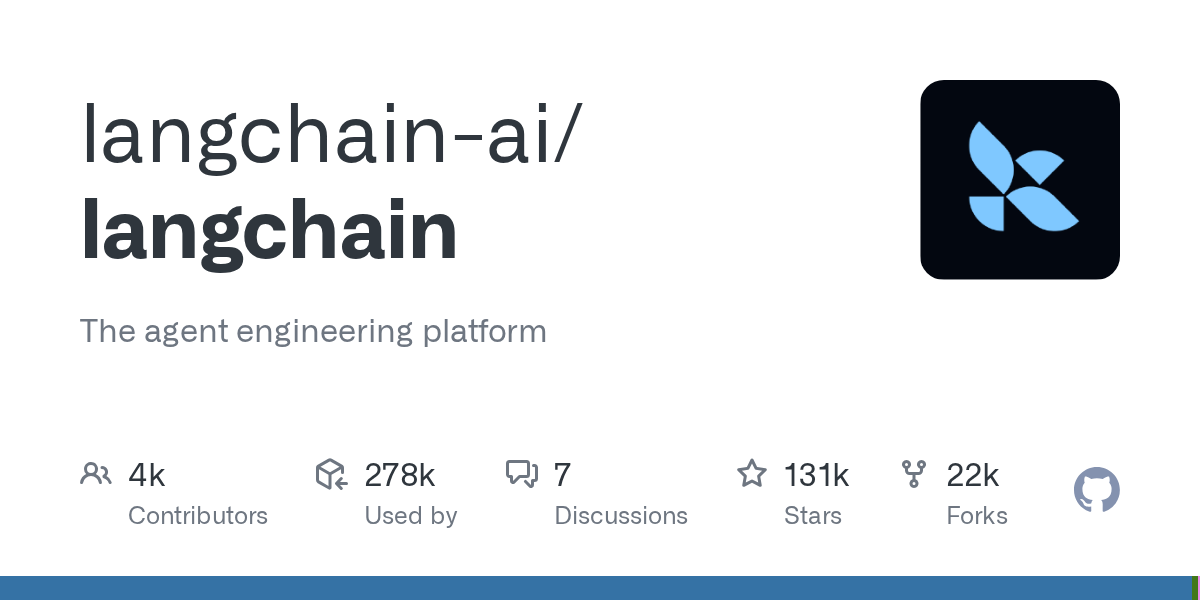
| ⭐ Stars (total) | 130,922 |
| 📈 Star Growth (Mar 18 → Mar 25) | +130,922 |
| 🔥 Star Growth (Mar 24 → Mar 25) | +94 |
| 🔥 Trend | Exploding |
| 📊 Trend Score | 104738 |
| 💻 Stack | Python |
Overview
LangChain has emerged as a dominant force in AI agent development, positioning itself as “the agent engineering platform.” With explosive growth of +130,922 stars this week and consistent daily momentum of +94 stars, it’s capturing unprecedented developer attention in the rapidly evolving AI infrastructure space.
Key Features
• Agent orchestration framework for building complex AI workflows and multi-step reasoning systems
• Modular architecture supporting integration with multiple language models and external tools
• Chain composition system for connecting different AI components and data sources
• Memory management capabilities for maintaining context across agent interactions
• Built-in support for document processing, retrieval systems, and vector databases
• Python-native implementation with extensive ecosystem compatibility
Use Cases
• Building conversational AI agents that can access external APIs, databases, and real-time information
• Creating automated research assistants that can gather, analyze, and synthesize information from multiple sources
• Developing customer support systems with multi-step problem-solving capabilities
• Constructing content generation pipelines that combine multiple AI models and data processing steps
• Building intelligent workflow automation tools for business process optimization
Why It’s Trending
This tool gained +130,922 stars this week, showing strong momentum in AI Agents. This suggests increasing developer interest in this approach. This trend may reflect a broader shift in how teams are building with AI, moving beyond simple chat interfaces toward more sophisticated agent-based architectures.
Pros
• Comprehensive ecosystem with extensive integrations and pre-built components
• Strong community support and active development with frequent updates
• Flexible architecture that accommodates different use cases and complexity levels
• Well-documented Python API with clear examples and tutorials
Cons
• Learning curve can be steep for developers new to agent-based AI systems
• Potential complexity overhead for simpler AI integration needs
• Rapid development pace may lead to breaking changes between versions
Pricing
Open source and free to use. The core framework is available under an open source license, though users will incur costs from underlying AI model APIs and cloud services.
Getting Started
Install via pip and explore the quickstart documentation to build your first agent chain. The extensive example gallery provides templates for common use cases.
Insight
The explosive growth trajectory suggests that developer demand for agent engineering tools is likely driven by the maturation of large language models and the need for more sophisticated AI applications. This momentum indicates that the market may be shifting from experimental AI projects toward production-ready agent systems. The timing can be attributed to enterprises seeking practical ways to deploy AI beyond basic chatbots into complex, multi-step business processes.


Comments