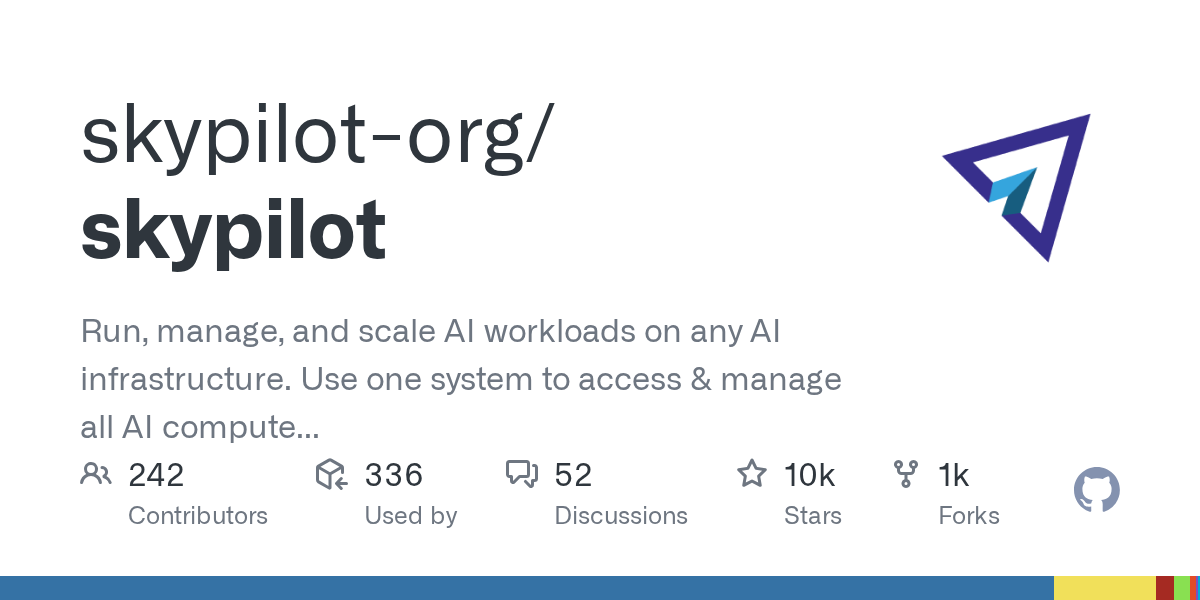
📊 Stats & Trend
| ⭐ Stars (total) | 9,696 |
| 📈 Star Growth (Mar 18 → Mar 25) | +9,696 |
| 🔥 Star Growth (Mar 24 → Mar 25) | +8 |
| 📈 Trend | Trending |
| 📊 Trend Score | 7757 |
| 💻 Stack | Python |
Overview
SkyPilot is gaining significant traction as a unified platform for managing AI workloads across diverse compute infrastructures. With +9,696 stars gained this week, it’s addressing the growing complexity of multi-cloud AI deployments by providing a single interface to access Kubernetes, Slurm clusters, 20+ cloud providers, and on-premises infrastructure.
Key Features
• Unified interface for managing AI workloads across multiple cloud providers and on-premises infrastructure
• Support for Kubernetes and Slurm cluster management systems
• Workload scaling capabilities across different compute environments
• Multi-cloud abstraction layer that simplifies infrastructure switching
• Python-based implementation for integration with existing AI/ML workflows
• Infrastructure-agnostic job scheduling and resource management
Use Cases
• ML researchers running large-scale training jobs across different cloud providers based on cost and availability
• AI teams managing hybrid deployments that span cloud and on-premises GPU clusters
• Organizations optimizing compute costs by dynamically switching between cloud providers
• Data science teams needing consistent workflow management across Kubernetes and traditional HPC environments
• Companies scaling AI workloads without vendor lock-in to specific cloud infrastructure
Why It’s Trending
This tool gained +9,696 stars this week, showing strong momentum in AI Infrastructure. This suggests increasing developer interest in unified multi-cloud AI management approaches. This trend may reflect a broader shift toward infrastructure flexibility as AI compute costs and availability become critical business considerations.
Pros
• Eliminates vendor lock-in by providing consistent interface across 20+ cloud providers
• Reduces complexity of managing diverse compute environments from a single control plane
• Supports both modern container orchestration (Kubernetes) and traditional HPC systems (Slurm)
• Python-native integration aligns well with existing ML development workflows
Cons
• Additional abstraction layer may introduce complexity for teams comfortable with native cloud tools
• Relatively new project may lack enterprise-grade features and extensive documentation
• Dependency on multiple underlying systems could create potential points of failure
Pricing
Open source and free to use. Users pay only for the underlying compute resources from their chosen cloud providers or infrastructure.
Getting Started
Install via Python package manager and configure credentials for your target cloud providers or clusters. The Python-based interface allows immediate integration with existing ML pipelines.
Insight
The rapid growth suggests that AI teams are increasingly seeking infrastructure flexibility rather than committing to single cloud providers. This trend is likely driven by the volatile pricing and availability of GPU resources across different platforms. The momentum may reflect a broader market shift toward treating AI compute as a commodity resource that should be easily portable across providers.


Comments