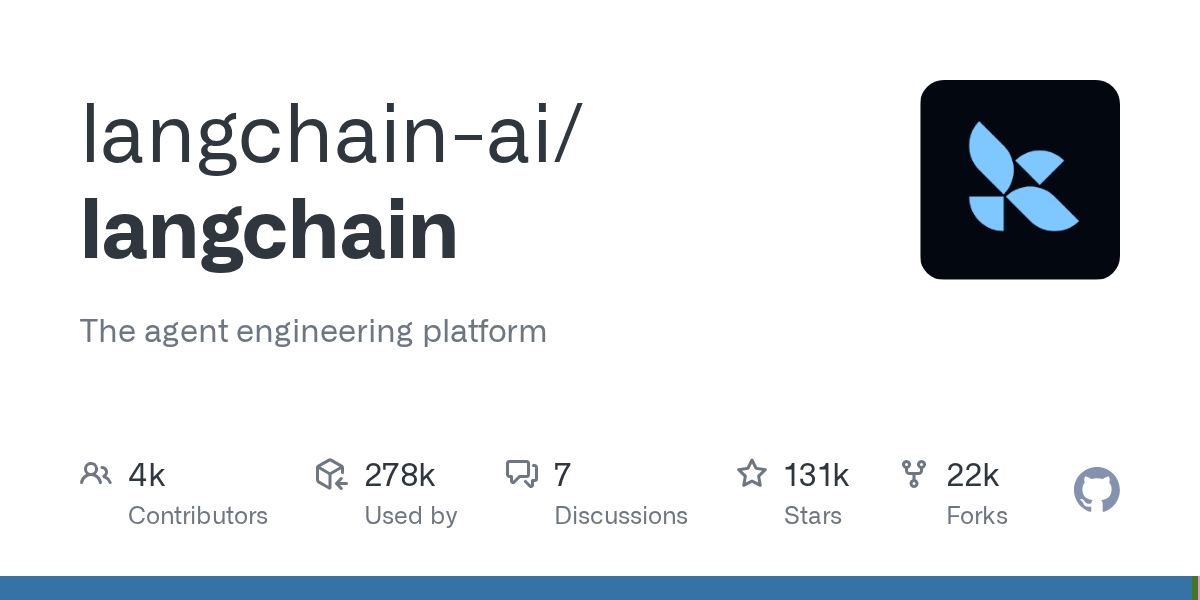
📊 Stats & Trend
| ⭐ Stars | 130,734 |
| 📈 Weekly Growth | +130,734 |
| 🔥 Today Growth | +130,734 |
| 🔥 Trend | Exploding |
| 📊 Trend Score | 104587 |
| 💻 Stack | Python |
Overview
LangChain is positioning itself as “the agent engineering platform” and has captured significant developer attention with explosive growth metrics. The tool gained +130,734 stars this week, indicating massive momentum in the AI agent development space as teams seek structured approaches to building intelligent applications.
Key Features
• Agent orchestration framework for building multi-step AI workflows
• Integration layer connecting large language models with external tools and APIs
• Chain composition system for linking multiple AI operations sequentially
• Memory management for maintaining context across agent interactions
• Debugging and monitoring tools for tracking agent behavior and performance
• Pre-built templates and components for common agent patterns
Use Cases
• Building customer service chatbots that can access databases and external systems
• Creating research assistants that gather information from multiple sources and synthesize findings
• Developing code generation tools that can execute, test, and iterate on solutions
• Automating content workflows that combine writing, fact-checking, and formatting tasks
• Building personal AI assistants that manage calendars, emails, and task coordination
Why It’s Trending
This tool gained +130,734 stars this week, showing strong momentum in AI Agents. This suggests increasing developer interest in this approach. This trend may reflect a broader shift in how teams are building with AI, moving from simple prompt-response patterns toward more sophisticated agent architectures.
Pros
• Comprehensive framework that handles common agent engineering challenges out-of-the-box
• Strong Python ecosystem integration making it accessible to data scientists and ML engineers
• Active development with frequent updates and community contributions
• Extensive documentation and examples for getting started quickly
Cons
• Learning curve can be steep for developers new to agent concepts
• Framework complexity may be overkill for simple AI integration tasks
• Rapid development pace means breaking changes and API instability
Pricing
Open source and free to use. Additional commercial services and enterprise support may be available but are not clearly specified.
Getting Started
Install via pip and explore the quickstart documentation to build your first agent chain. The platform provides templates for common patterns like retrieval-augmented generation and tool-using agents.
Insight
The explosive growth in LangChain’s adoption suggests that the developer community is moving beyond basic LLM integrations toward more sophisticated agent architectures. This momentum may reflect increasing enterprise demand for AI systems that can perform multi-step reasoning and interact with existing business tools. The timing indicates that teams are likely seeking production-ready frameworks as AI agent development matures from experimentation to deployment.
Comments