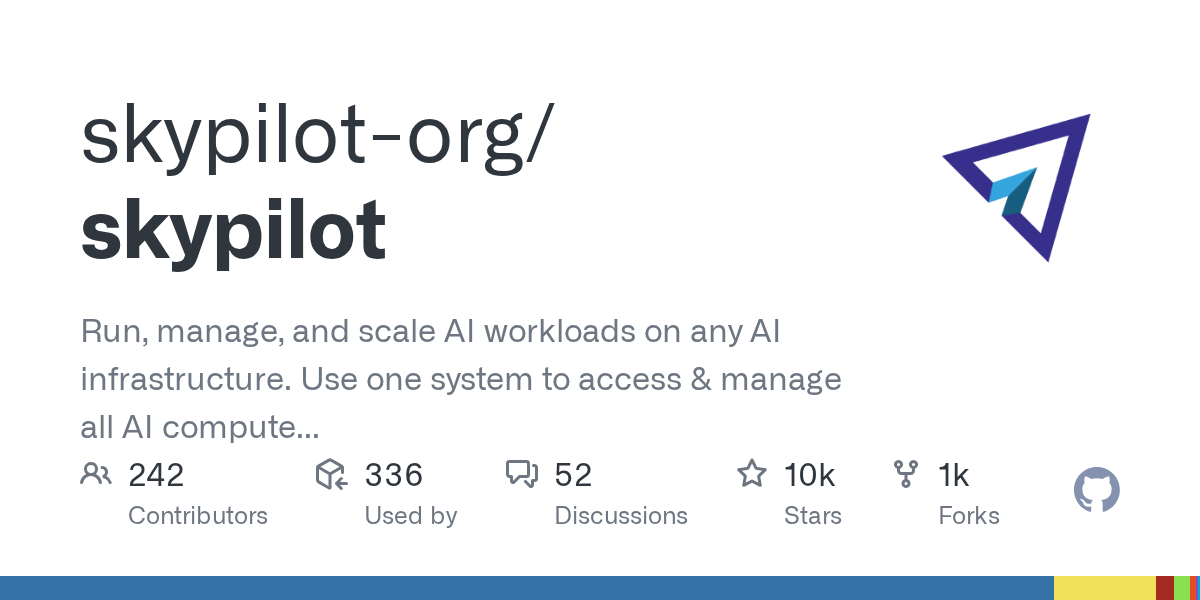
📊 Stats & Trend
| ⭐ Stars | 9,682 |
| 📈 Weekly Growth | +9,682 |
| 🔥 Today Growth | +9,682 |
| 📈 Trend | Trending |
| 📊 Trend Score | 7746 |
| 💻 Stack | Python |
Overview
SkyPilot has emerged as a significant player in AI infrastructure management, gaining substantial developer attention with its unified approach to multi-cloud AI workload orchestration. This tool gained +9,682 stars this week, positioning it as a trending solution for teams struggling with fragmented AI compute resources across different platforms.
Key Features
• Multi-cloud AI workload execution across 20+ cloud providers including AWS, GCP, Azure, and on-premises infrastructure
• Kubernetes and Slurm cluster management through a single unified interface
• Automatic resource provisioning and scaling for AI training and inference workloads
• Cost optimization through intelligent cloud selection and spot instance utilization
• Python-based configuration and deployment system for seamless integration
• Cross-platform job scheduling and queue management capabilities
Use Cases
• Machine learning teams running distributed training across multiple cloud providers to optimize costs and availability
• Research institutions managing AI experiments across hybrid cloud and on-premises HPC clusters
• Startups scaling AI workloads without vendor lock-in while maintaining cost efficiency
• Enterprise teams standardizing AI infrastructure management across diverse compute environments
• DevOps engineers automating AI model deployment pipelines across heterogeneous infrastructure
Why It’s Trending
This tool gained +9,682 stars this week, showing strong momentum in AI Infrastructure. This suggests increasing developer interest in unified multi-cloud AI orchestration solutions. This trend may reflect a broader shift toward infrastructure abstraction as AI workloads become more complex and resource-intensive.
Pros
• Eliminates vendor lock-in by supporting 20+ cloud providers and on-premises infrastructure
• Reduces infrastructure complexity through unified management interface
• Enables cost optimization through intelligent resource selection and spot instance usage
• Provides seamless integration with existing Kubernetes and Slurm environments
Cons
• Learning curve required for teams unfamiliar with multi-cloud orchestration concepts
• Dependency on multiple cloud provider APIs may introduce potential points of failure
• Complex networking configurations may be required for hybrid deployments
Pricing
Open source and free to use. Users pay only for underlying cloud resources consumed.
Getting Started
Install via pip and configure cloud credentials for desired providers. The Python-based configuration system allows quick setup of multi-cloud AI workloads.
Insight
The rapid adoption of SkyPilot suggests that AI teams are increasingly facing infrastructure fragmentation challenges as workloads scale. This growth pattern indicates that the market is likely driven by the need for cost-effective AI compute management across diverse environments. The timing may reflect organizations seeking alternatives to single-cloud dependencies as AI infrastructure costs continue rising.

Comments