📊 Stats & Trend
| ⭐ Stars | 2,523 |
| 📈 Weekly Growth | +2,523 |
| 🔥 Today Growth | +2,523 |
| 📊 Trend | Stable |
| 📊 Trend Score | 2018 |
| 💻 Stack | JavaScript |
Overview
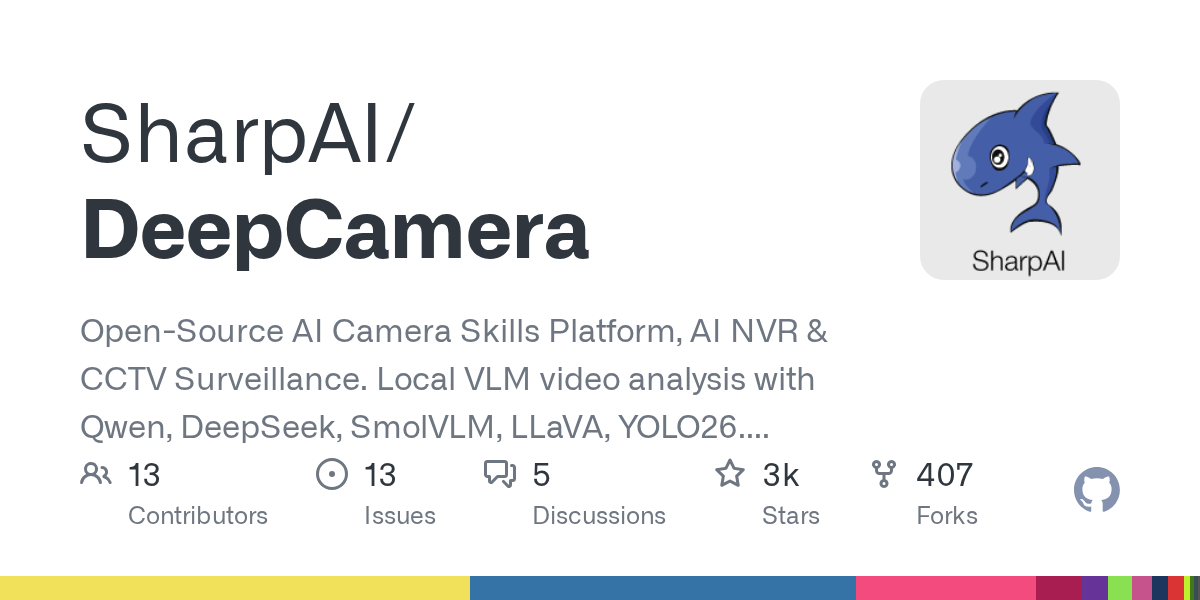
DeepCamera is rapidly gaining developer attention as an open-source AI-powered surveillance platform that combines local video analysis with large language models. With +2,523 stars gained this week, it represents a notable shift toward privacy-focused, locally-run AI camera systems that can understand and respond to visual events through popular messaging platforms.
Key Features
• Local visual language model integration with Qwen, DeepSeek, SmolVLM, LLaVA, and YOLO26 for on-device video analysis
• LLM-powered security agent that watches, understands, remembers, and guards locations autonomously
• Multi-platform notifications through Telegram, Discord, and Slack integrations
• Pluggable AI skills architecture supporting OpenAI, Google, Anthropic, or local AI models
• Network Video Recorder (NVR) and CCTV surveillance capabilities
• Optimized for Mac Mini and AI PC hardware configurations
Use Cases
• Home security monitoring with intelligent threat detection and instant messaging alerts
• Small business surveillance systems requiring privacy-compliant, local AI processing
• Research projects studying computer vision and natural language integration in IoT devices
• Developer experimentation with agentic AI systems in physical security applications
• Privacy-conscious organizations needing surveillance without cloud dependencies
Why It’s Trending
This tool gained +2,523 stars this week, showing strong momentum in AI-powered surveillance solutions. This suggests increasing developer interest in combining local AI processing with traditional security camera infrastructure. This trend may reflect a broader shift toward privacy-preserving AI applications that process sensitive video data locally rather than in the cloud.
Pros
• Complete local processing eliminates privacy concerns associated with cloud-based video analysis
• Supports multiple leading AI models providing flexibility in performance and accuracy trade-offs
• Open-source architecture allows customization and community-driven improvements
• Integration with popular messaging platforms enables immediate actionable alerts
Cons
• Requires significant local hardware resources for optimal AI model performance
• Setup complexity may challenge users without technical AI deployment experience
• Limited documentation and community support compared to established commercial solutions
Pricing
Free and open-source. Users only need to account for hardware costs and any third-party AI service API usage.
Getting Started
Clone the repository from GitHub and follow the installation guide for your target hardware platform. The project includes configuration examples for various AI models and messaging platform integrations.
Insight
The rapid adoption suggests that developers are increasingly prioritizing local AI processing for privacy-sensitive applications like surveillance. This momentum may reflect growing concerns about cloud-based video analysis and indicates strong demand for open-source alternatives to proprietary security systems. The combination of multiple VLM options with messaging integration is likely driven by the need for both technical flexibility and practical usability in home and small business contexts.
Comments